


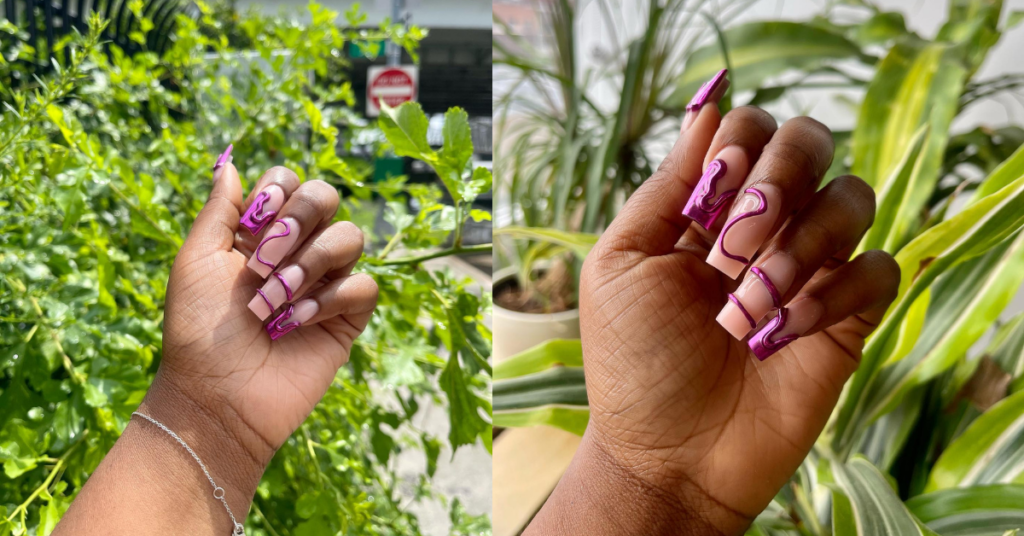
IG: shamma_beneche
A chipped nail on vacation is annoying because it’s never just cosmetic. One tiny chip turns into snagging on towels, hair, swimsuit straps, and suddenly you’re picking at the edge and making it worse.
The trick is to decide what kind of “set” you have first (regular polish, gel, acrylic/dip, press-ons), then choose the lightest fix that stops snagging and blends in. On vacation you’re not chasing perfection, you’re chasing “nobody notices from 30 cm away and it doesn’t catch on anything.”
Also, one honest note: if your nail is cracked into the nail bed, bleeding, or lifting with pain, skip the DIY and protect it. Cosmetic fixes are not worth an infection.
Quick fix options (pick your situation)
- Tiny chip, regular polish: smooth edge + dab color + top coat.
- Polish chipped to bare nail: “micro-patch” with clear top coat (or clear + glitter on that nail).
- Crack starting to split: teabag or tissue patch + clear coat to reinforce.
- Gel polish chip: lightly buff the jagged edge + seal with clear top coat (not perfect, but it stops snagging).
- Acrylic/dip chip: file smooth + clear top coat. If it’s lifting, do not glue it down if your natural nail feels exposed.
- Press-on popped or corner lifted: clean, dry, re-glue or use adhesive tabs.
If you only do one thing: file the snag smooth and seal it with any clear top coat you can find. That alone prevents the “chip becomes a rip” spiral.
Step 1: Identify your nail type (30 seconds)
- Regular polish: feels like your natural nail, chips in flakes.
- Gel polish: harder, glossy, chips often look like a “plate” lifting or a chunk missing.
- Acrylic / dip / builder gel: thicker nail, you can feel the bulk. Chips look like missing thickness.
- Press-ons: you can see a seam or feel the edge, may lift at sides.
This matters because some fixes stick to natural nails but fail on gel or acrylic.
Your mini “vacation nail triage” routine
Step 2: Stop the snag first (the most important step)
- Wash hands, dry completely.
- File in one direction to smooth the chipped edge (hotel emery board, nail file, even a clean matchbook-style file from a mini kit).
- If you don’t have a file: use the smooth side of a hotel key card or a clean denim edge very gently. This is not elegant, but it reduces catching.
This won’t work if the nail is cracked deep and flexing painfully. In that case, skip filing aggressively. Protect it instead (bandage + tape) until you can fix it properly.
Step 3: Clean the surface (so your fix sticks)
- Wipe the nail with soap and water and dry well.
- If you have it: swipe with alcohol (hand sanitizer can work in a pinch, but let it fully evaporate).
Fixes by nail type
A) Regular polish: the clean “blend-in” fix
Option 1: The quick patch (best for small chips)
- Smooth the chip with a file.
- Dab a tiny bit of matching polish just on the bare spot.
- Wait 60-90 seconds.
- Add a top coat over the whole nail.
Tip: if your color is sheer or nude, you can often get away with top coat only.
Option 2: The “one-nail disguise” (best if you don’t have matching color)
If you can’t match the polish:
- Paint just that nail with clear + glitter, or a slightly different neutral.
- Or do a “feature nail”: clear top coat + a small sticker, or even a tiny dot near the cuticle.
Trade-off with no perfect solution: if the original set is a very specific color (like a bright coral) and you only have a random mauve, it will never fully disappear. Aim for “intentional accent nail,” not “perfect match.”
Option 3: Reinforce a crack (teabag method)
Use this if the nail is splitting but still attached.
You need:
- a small piece of teabag paper (or thin tissue)
- clear top coat (or clear polish)
Steps:
- Cut a tiny patch slightly bigger than the crack.
- Paint a layer of clear polish over the crack.
- Place the patch on top, press flat.
- Add another layer of clear polish.
- Once dry, gently file the edges smooth.
- Add one more top coat.
It looks surprisingly clean, and it stops the split from traveling.
B) Gel polish: “seal it and survive” fix
Gel chips are annoying because you can’t properly re-cure without a lamp. On vacation, you’re mostly trying to prevent lifting and snagging.
Option 1: Smooth + clear seal
- Use a file to carefully smooth the raised edge.
- Very lightly buff just the chipped area so it’s not sharp.
- Apply a layer of clear top coat (regular polish top coat is fine).
- Reapply top coat daily if needed.
It won’t look like a salon repair, but it stops hair-snags and further peeling.
Option 2: Turn one nail into a glossy neutral
If one nail looks too obvious:
- Remove polish from just that nail (only if it comes off easily without ripping).
- Then do two coats of clear or a sheer nude if you can find it.
Important: Do not peel gel off. That’s how you take layers of your natural nail with it.
C) Acrylic / dip: file, seal, and avoid “glue traps”
If it’s a small chip (no lifting)
- File the chipped area to smooth the shape.
- Seal with clear top coat.
If it’s lifting (you can catch an edge)
This is where people ruin the whole set.
- Do not glue a lifted acrylic back down if the natural nail underneath feels exposed or you see a gap you cannot clean. Trapping moisture and bacteria is the risk.
- Best vacation fix: gently file the lifted edge so it stops catching, then cover with a clear coat, and book a repair when you can.
If you have to choose between “it’s not perfect” and “I might get a nasty green spot,” choose not perfect.
D) Press-ons: reattach like it’s a clean-room procedure
Press-ons fail because of oil, water, sunscreen, and rushed glue.
Best quick reattach
- Wash and dry hands.
- Clean the underside of the press-on and your natural nail (soap and water, then dry; alcohol helps).
- Buff lightly if you have a file (optional).
- Apply nail glue (or an adhesive tab).
- Press firmly for 30-60 seconds.
Optional. Skip it if you’re in a hurry: avoid water for 1 hour after reattaching. It really helps longevity, but you can live without it.
If you lost the press-on entirely:
- File your natural nail smooth
- Paint clear polish
- Or make it an accent nail (glitter, sticker, different neutral)
The “vacation emergency kit” (tiny, worth it)
If you can grab anything from a drugstore or hotel shop, prioritize:
- mini nail file or emery board
- clear top coat (or clear polish)
- nail glue (for press-ons only, or emergency crack patching)
- small scissors or tweezers (for patches)
- cuticle oil (optional, but helps everything look intentional)
If you have nothing: a file + clear top coat solves 80 percent of problems.
How to make it look intentional (even if it’s not perfect)
- Add extra glossy top coat to all nails so the repaired one blends.
- Put a ring on that hand if you’re taking photos and the repair is obvious.
- If it’s one nail only, do a matching accent on the same nail of the other hand. That’s the easiest optical trick.
Mistakes that ruin the whole set
- Picking at lifting gel (turns one chip into full removal damage).
- Over-filing acrylic until you hit thin spots.
- Gluing down lifting enhancements with trapped moisture.
- Trying to match color perfectly in bad lighting and ending up with a worse mismatch.
- Skipping drying time and smudging, then layering more polish over goo.
When to stop DIY and protect the nail
Get help or keep it covered if:
- the crack reaches the nail bed and hurts
- there’s bleeding
- the enhancement is lifting with a big gap
- you see greenish discoloration or smell something off
- the area is warm, swollen, or throbbing
A simple bandage + tape to prevent snagging is completely acceptable for a day or two.
Fast decision guide
Keep it simple if:
- it’s a tiny chip
- it’s not lifting
- you just need it not to snag
Do a patch if:
- the nail is cracking and you need reinforcement
Avoid glue if:
- anything is lifting and you cannot clean/dry underneath
Just a little note - some of the links on here may be affiliate links, which means I might earn a small commission if you decide to shop through them (at no extra cost to you!). I only post content which I'm truly enthusiastic about and would suggest to others.
And as you know, I seriously love seeing your takes on the looks and ideas on here - that means the world to me! If you recreate something, please share it here in the comments or feel free to send me a pic. I'm always excited to meet y'all! ✨🤍
Xoxo Emily